PROJECT 02 / IN DEVELOPMENT
Leap-2.Built smarter. Going bigger.
Folded sheet metal. Larger printed wheels. Our own robotic arm. The next LEAP rover takes a different approach to building a capable exploration platform.
Current phase: design & requirements
Leap-2 / AI-GENERATED CONCEPT / DESIGN NOT FROZEN
01 / CONCEPT STUDY
More rover.Less dead weight.
A larger exploration platform with a lighter structural approach. Folded sheet metal, custom TPU wheels and an in-house manipulator form the next chapter of the LEAP programme.

HSM ARIES / PROJECT 02
A new mission.
The same Aries spirit.
DESIGN EXPLORATION / 01Concept visualisation · Leap-2 is in development.
01Fold it. Weld it. Make it lighter.+
Folded galvanised sheet panels form the chassis. Laser-cut metal sheets are welded into hollow box sections for the suspension arms. The aim is rigidity through section geometry with less structural mass.
02Our wheels, scaled up.+
In-house 3D-printed TPU wheels continue from LEAP-One. The new diameter target is 2.5 times larger, with an airless structure. Tread, lattice, hub interfaces and drive loads are part of the development work.
03A custom arm from the ground up.+
Leap-2 replaces the bought-in Igus arm with a team-designed manipulator. Faster movement, lower moving mass and greater task capability are the goals. Link materials, actuators, payload and speed are under development.
04See the terrain. See the task.+
LEAP-One uses multiple front RealSense cameras, a RealSense near the gripper and a Logitech mast camera. Leap-2 builds on that distributed view with 360° cameras and LiDAR for greater positional awareness. Exact new sensor models and installation positions are still being developed.
02 / DESIGN BRIEF
Four priorities.One better platform.
The hardware direction answers real field experience. LEAP-One’s results show where the next platform needs to improve.
- 01
Traverse
LEAP-One: 43 / 340
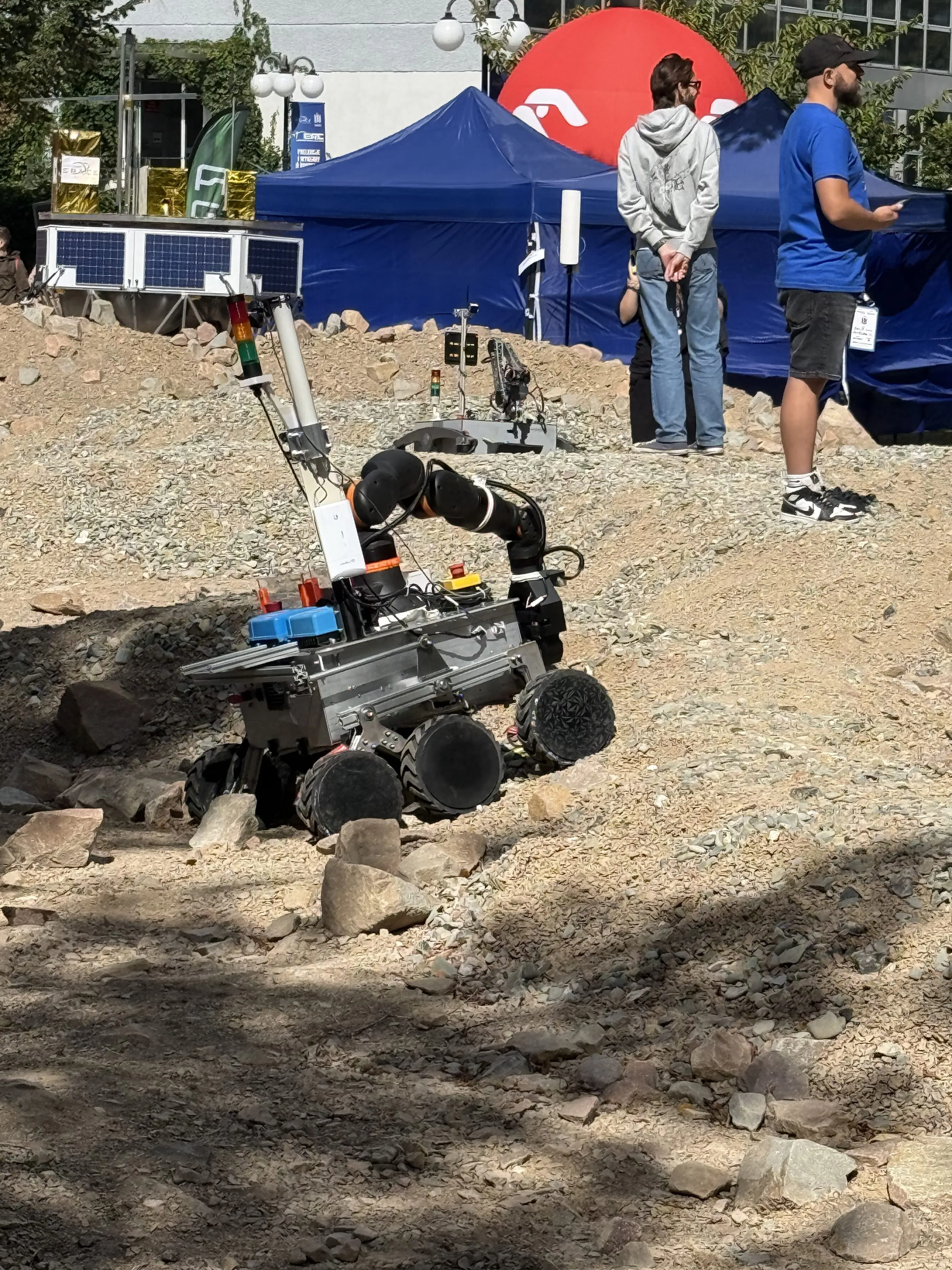
Autonomy from the first frame.
Integrate the carried-forward perception and control hardware with navigation from the start.
What happened at ERC
The suspension carried LEAP-One over the rocky slope of the Mars yard. The traverse task, which rewards autonomous navigation across it, closed at 43 points.
- 02
Maintenance
LEAP-One: 66 / 340

An arm built for our mission.
Develop our own manipulator, targeting faster motion, lower moving mass and greater task capability than the bought-in arm.
What happened at ERC
On the rain day the arm ran wrapped in protective plastic under an umbrella. The maintenance task scored 66 of 340.
- 03
Mass
LEAP-One: −22 / 200

Strength through geometry.
Replace solid aluminium plates with folded galvanised sheets and laser-cut, welded box-section suspension links. Budget mass across the complete rover.
What happened at ERC
The chassis was rebuilt on the pavement before the first run. LEAP-One was over the mass allowance and scored −22 on a line worth up to 200 points — nine teams took the full 200; no other team went negative.
- 04
Probing
LEAP-One: 12 / 240
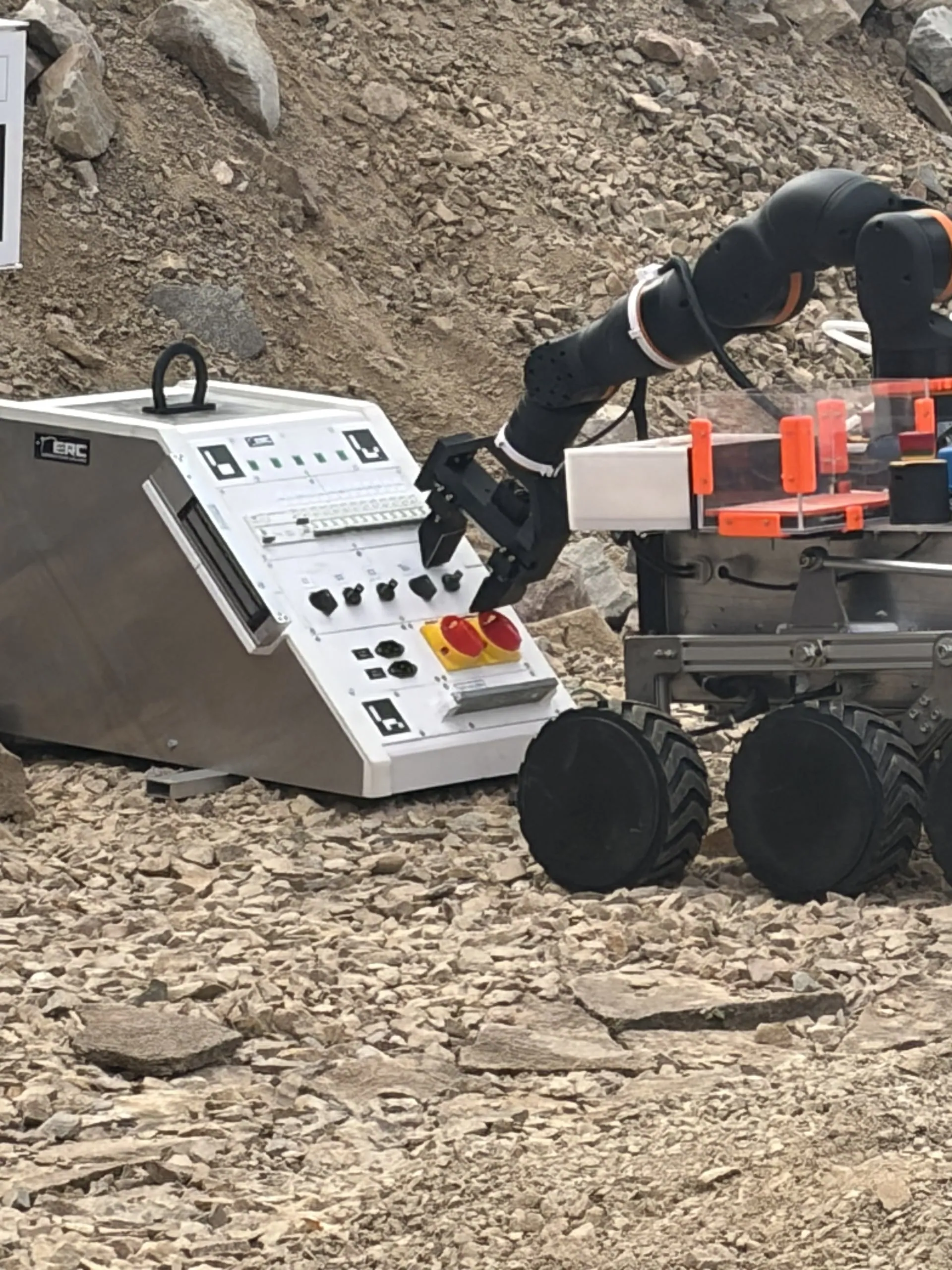
Rehearse the complete task.
Develop the probing tool and its operating workflow together, then rehearse the complete task before field testing.
What happened at ERC
The gripper worked the switches on the maintenance panel, but the probing task closed at 12 of 240 — the lowest task score on the sheet.
Photographs show LEAP-One at ERC 2026.
03 / CARRIED FORWARD
Real hardware.A familiar foundation.
Most of LEAP-One’s components form the starting point for Leap-2. These are the documented baseline parts; integration into the new platform remains under review.
LEAP-One component baseline+
- Perception
- Multiple Intel RealSense cameras
D435i is recorded in the autonomy stack; front cameras and a wrist camera near the gripper carry the perception approach forward. - Positional awareness
- 360° cameras + LiDAR
Planned for Leap-2. Exact models and mounting geometry remain to be selected. - Motor control
- Botwheel BLDC + ODrive S1
The six-wheel drive baseline; larger wheels require drivetrain validation. - Compute
- ASUS ROG NUC 15 + Teensy 4.1
Onboard computing and low-level control baseline. - Power
- LiFePO₄ · 25.6 V / 60 Ah
LEAP-One’s 2S2P battery architecture. - Communications
- Ubiquiti AirMAX + ExpressLRS
Primary data link and independent backup command path. - Software
- ROS 2 + Mission Control
Perception, navigation, telemetry and operator workflows.
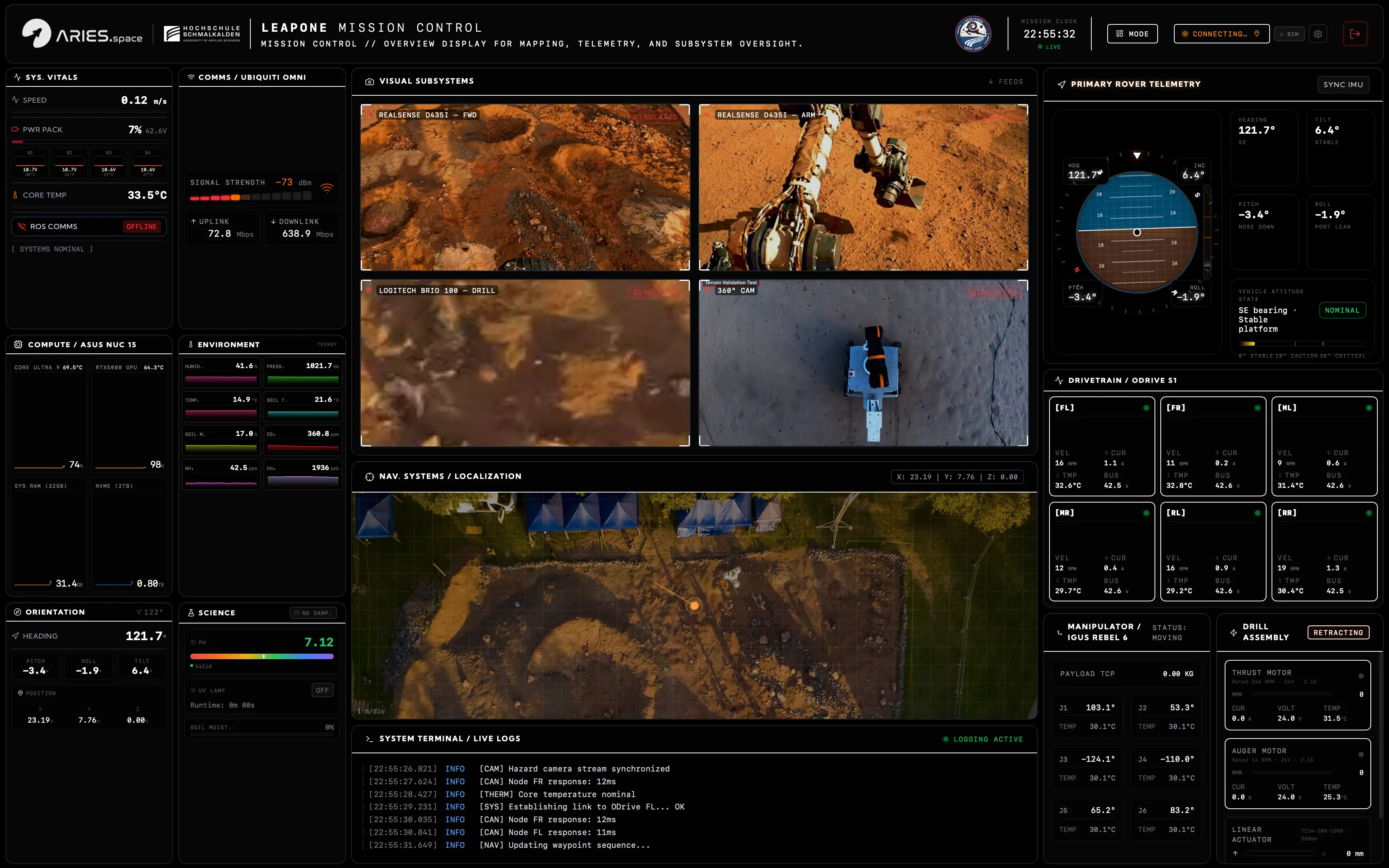
OPERATIONS SOFTWARE
One crew.
One Mission Control.
Mapping, telemetry, cameras and subsystem control share the operator environment used at the finals.
Explore Mission Control →- Documentation
- 364.25 / 400 · 4th
- Navigation droning
- 265 / 300 · 6th
04 / THE STARTING POINT
Lessons from the field.
DESIGN PHASE / JOIN THE BUILD
The next leap
needs your ideas.
Eight departments. One shared platform. Help turn the design brief into the next LEAP rover.