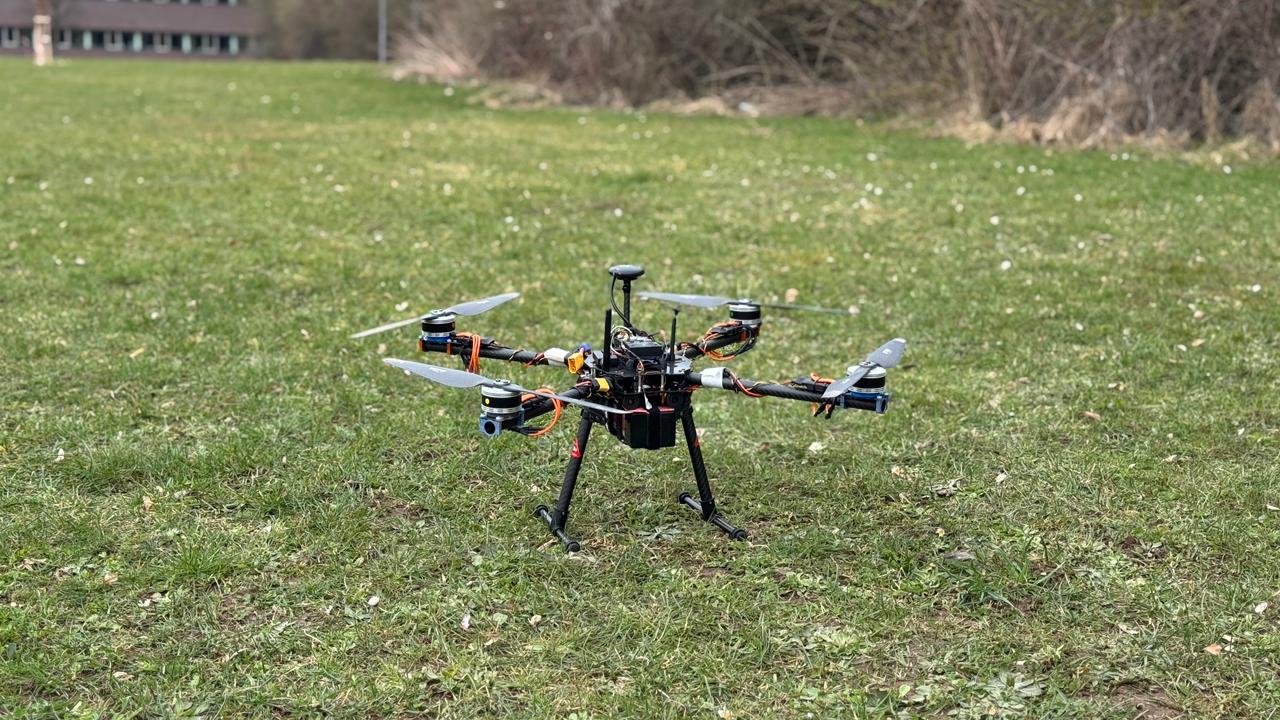

Schmalkalden, Germany — Following our successful assembly phase in January, the HSM Aries.space Drone Department officially moved from the laboratory to the field. Our latest UAV, AQUILA, underwent rigorous manual flight testing to evaluate its aerodynamic stability and responsiveness under real-world wind conditions.
Pilot Evaluation: Precision & Power
The primary objective of this session was to assess how the craft translates pilot inputs into physical movement. Our lead pilot executed a complex flight plan, including high-speed passes, vertical climbs, and precision hovering.
Key performance takeaways from the field:
- Power-to-Weight Ratio: The drone demonstrated an exceptional power profile, allowing for near-instantaneous recovery from sudden wind gusts.
- Pilot Ergonomics: We prioritized the “feel” of the controls to ensure the platform remains intuitive during high-stress competition scenarios at ERC 2026.
- Telemetry Reliability: The data link remained rock-solid, providing the ground station with real-time analytics on battery voltage and motor temperatures.
Technical Refinement: Optimization via PID Tuning
While the flight was a resounding success, our high-speed descent tests revealed a slight oscillation. This is a common challenge in high-performance UAV engineering. Our software team is already addressing this by fine-tuning the PID (Proportional-Integral-Derivative) values within the flight controller to ensure perfectly smooth descents in future missions.
The Roadmap to Autonomy
The success of these manual trials marks a major transition for the AQUILA project. With full confidence in our hardware’s physical flight characteristics, we are now moving toward semi-autonomous flight modes.
Our next phase will integrate onboard sensors for:
- Precision Position-Holding
- Active Obstacle Avoidance
- Autonomous Waypoint Navigation